
for coachesGeneric AI advice is free now. The coaches who thrive will be the ones whose clients get their Coaching — everywhere, between every session. I build you that.
Your clients' AI is already in the room. At 7am before the hard conversation, mid-investor-email at 11pm — they're asking. The only question is whether the answer is generic advice, or your frameworks with your name on them.
Your IP is your moat — once it's alive. Structured and linked, your body of work becomes an asset that compounds: findable by clients, usable by their AI, growing every week you coach. Buried in a Notion graveyard, it's just an archive.
I'm a coach who builds. So I built mine first — and this offer is the same system, applied to your Coaching.

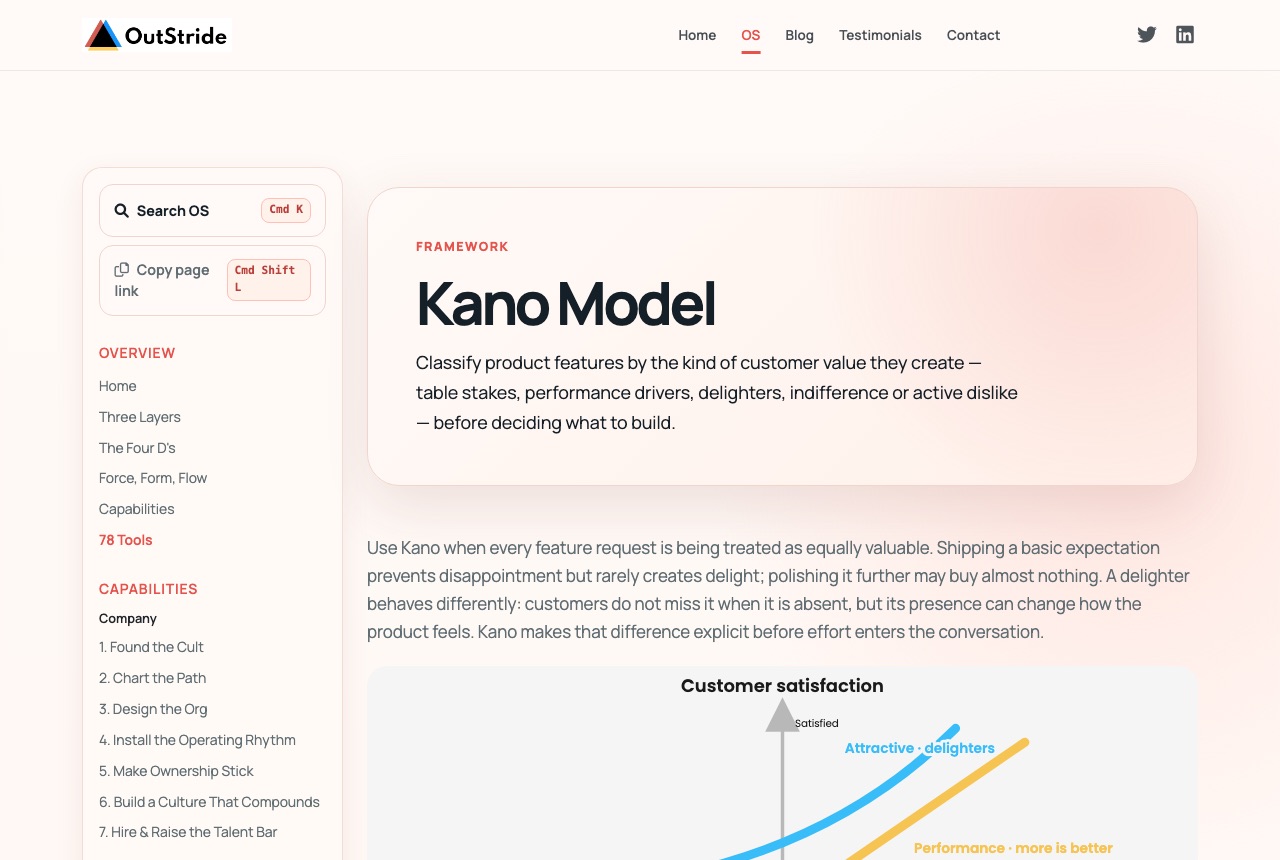
The Outstride OS: 25 capabilities, 78 tools, every diagram generated from text. Explore it live →
Your OS on your own domain: mini-essays for your concepts, a searchable tool library, ⌘K navigation. Follow up a discovery call or a session with your own branded link — not a book chapter and a Google result.
A one-click MCP connector puts your OS inside their Claude or ChatGPT. When your founder preps that hard conversation, the answer arrives in your frameworks, linking to your pages. On the roadmap: a private layer with each client's own goals and commitments.
If you can leave a voice note, you can grow it. You talk; agents draft; you approve from your phone. And the Self-Improvement Loop reads your week of session notes and proposes updates — you just review and publish.
Under the hood, for the skeptics: everything is typed, structured data your AI can read holistically · diagrams are generated from text, so nothing ever needs redrawing · you own the code and the content — no lock-in, ever.
These are real answers drawn from my OS. Pick a question.
This demo is drawn from my live OS — add it to your own Claude and ask it anything: outstride.co/os
Live in about three weeks. Around four hours of your time — almost all of it talking.
Thirty minutes. We define what success looks like and tour my OS together — bring the framework you're proudest of. You leave knowing whether this is for you.
Ninety minutes together, then I draft. You get a one-page map of your system — and nothing gets built until you've signed it off.
Within a week you get a URL: two of everything, fully linked, your name on it. The moment it stops being an idea.
Two or three guided voice sessions — you talk, agents draft, we review. Your only job is to think out loud.
A recorded working session, your own “how to update my OS” guide, and thirty days of support. From there you're running it — with the Care Plan behind you, or on your own.
Pilot pricing is available for early partners in exchange for a case study and introductions. Referral partners share revenue on an open–close–execute split. Coming soon for Care Plan coaches: a Client Portal where your clients see their goals, scores and progress between sessions.
The principles I build to, and exactly what you get every month. Nothing here changes without me telling you.
The rules I build to. They are why the system stays cheap to change and useful to an AI — and why it stays yours.
Your content is stored as typed, structured data — a capability knows which tools serve it, a tool knows its steps and where it sits in your taxonomy. The visual design is a layer painted on top.
Structured content can be searched, linked, re-skinned, exported and read holistically by an AI. Pretty pages full of free text can only be read one at a time, by a human.
Every framework and concept you use gets its own page with a stable address. Not a section inside a mega-doc, not a slide in a deck.
The test: after a session you can send one link that is exactly the thing you just taught. It still works next year, and it is the unit your clients' AI cites.
Tools point to the capabilities they build; capabilities point back to their tools. Symptoms point at the tools that treat them.
Two-way links let a client or an AI arrive from any direction — "my VP isn't holding his team accountable" lands on the right tool without knowing your taxonomy first.
Your models are defined as data and rendered by the site. Change a label once and every place it appears updates.
The alternative is a folder of PNGs exported from a whiteboard tool that nobody can face updating. That is how frameworks quietly freeze.
You update your own content. Not because I want to make you work — because a second brain someone else feeds is not a second brain, it's a brochure. The thinking has to stay yours or the whole thing goes stale the moment you get busy.
So the system is built for you to run: leave a voice note, agents draft it in your structure, you approve from your phone. Distinctive phrasings are kept verbatim — if you say "a marathon with periods of sprinting", that is what the page says.
My job is to make that loop fast and to unstick you when it jams. Not to be your ghostwriter.
It is a static site built from plain text files in a repository you own. No proprietary database, no per-seat platform fee, nothing that stops working if you stop working with me.
If you leave, you leave with the code, the content and the deploy pipeline. That constraint keeps me honest about earning the Care Plan every month.
The Care Plan is $295/month, billed quarterly. It keeps the machine running and keeps you unstuck — you still drive the content.
Note what isn't on that list: writing your content. That's yours, deliberately — see "You hold the pen" above.
Not as a monthly service, no. During the build I run the capture sessions with you and we draft together — that's what the Full Build is for, and it's where you learn the loop.
After that you run it. If you genuinely want a batch of content produced — a book's worth of frameworks, a big migration — that's a separate scoped piece of work, not something quietly absorbed into $295 a month.
New functionality rather than upkeep: a client portal, a rebrand, a bespoke diagram type, an integration with your CRM or scheduling tool, a migration to a different host.
Those get scoped and quoted before any work starts. The MCP Connector and the Self-Improvement Loop are the two most common, which is why they have fixed prices rather than estimates.
No, and yes. The build stands alone — you own the code and content, and the handover session plus your own written "how to update my OS" guide are designed for you to run it unaided.
It's billed quarterly and you can stop at the end of any quarter, no notice period. I hand over hosting and the deploy pipeline and your site keeps working. Nothing is held hostage.
Weekly, an agent reads that week's session notes and compares what you actually taught against what's in your OS. It reports gaps — a framework you used three times that has no page, a tool whose page no longer matches how you teach it.
You get a short written proposal and approve the ones you want. It never edits your OS directly. The first time I ran it over my own week, it found a fundraising tool I had apparently taught three times and never written down.
You own both, outright, from day one. Your IP stays yours; the site code is yours to keep, fork or hand to another developer.
I keep the right to reuse the underlying template — the thing that makes the next coach's build faster — but never your frameworks, your words or your clients' anything.
Not in the public OS. That layer is your frameworks and your writing only — nothing about a named client, ever.
The private per-client layer is a separate, authenticated thing, opt-in per client with their explicit consent. The hard part of that feature is the consent model, not the technology, and I'd rather move slowly on it than get it wrong.
It's the opposite of the risk you're actually running. Your clients are already asking AI these questions — the only choice is whether the answer sounds like you and links to you, or sounds like everyone.
You choose what goes in the public layer. The deep work, the judgement and the relationship were never the part a model could take.
About three weeks from Success Call to live, and roughly four hours of your time — almost all of it talking rather than writing. You don't need to be technical: if you can leave a voice note and tap approve, you can run this.
The pace is set by how quickly you can review drafts, not by how quickly I can build.
Nobody's are. The Taxonomy Deep Dive usually surfaces two or three things you've been teaching for years without naming, and naming them is half the value.
Pages carry a status, so half-formed ideas can live in the system as drafts rather than being lost.
Coaches without a body of work yet — if you're still finding your approach, structuring it prematurely will get in your way.
And anyone who wants a marketing website, or who wants someone else to keep it fed. This is a working system you run; if the goal is lead-gen copy, hire a web designer.
Make sure it answers with your Coaching.
Book a 30-minute Success Call